Money & Growth · Mechanism
The Psychology of Money Habits: Why Saving Feels So Hard
Americans save just 3.0% of income, and willpower isn't the fix. The psychology of money habits, plus the proven system that grew saving from 3.5% to 13.6%.
 by Alex July 12, 2026 16 min read
As of May 2026, the US personal saving rate sits at 3.0% (Bureau of Economic Analysis, 2026). Out of every $1,000 that lands after taxes, thirty dollars gets saved. And in the Federal Reserve’s latest well-being survey, only 63% of adults could cover a $400 emergency with cash or its equivalent (Federal Reserve SHED, 2025).
Here’s the part nobody says out loud: that’s not a national discipline shortage. Money habits run against old, well-documented wiring in your brain. Once you see the wiring, the fixes get obvious, and none of them involve trying harder.
One note before we start. This is behavior science, not financial advice. Nothing here tells you where to put your money. It explains why your brain fights you when you try to keep it, the same way motivation fails every other habit.
The Bottom Line
- Your brain processes future-you like a stranger, which makes saving feel like giving money away (Hershfield, 2009).
- Intentions explain only about 28% of behavior (Sheeran, 2002). Systems have to do the rest.
- A 9,035-person trial found budgeting apps didn’t change spending at all (Irrational Labs). Automation beats monitoring.
- One automatic program raised saving rates from 3.5% to 13.6% in 40 months (Thaler & Benartzi, 2004).
In this guide:
- Why does saving feel so hard?
- Why does future-you feel like a stranger?
- Why does a card hurt less than cash?
- The myth: a budgeting app will fix your spending
- What actually works when willpower doesn’t?
- The scarcity tax: money stress isn’t just uncomfortable
- The lottery winner problem: more money doesn’t fix the feeling
- How do you start when money stresses you out?
- FAQ
Why does saving feel so hard?
Because saving runs on intentions, and intentions are weak fuel. A meta-analysis of meta-analyses found that intentions explain only about 28% of the variance in actual behavior (Sheeran, 2002). The 3.0% national saving rate isn’t a character flaw at scale (Bureau of Economic Analysis, 2026). It’s what intentions produce without systems.
Sit with that 28% number for a second. You can sincerely, deeply intend to save this month and still watch the month end with nothing moved. Not because you’re weak. Because intention was never the mechanism that moves money.
The $400 question makes it concrete. In the Fed’s 2025 survey, 63% of adults said they’d cover a surprise $400 expense with cash or its equivalent (Federal Reserve SHED, 2025). The other 37% would borrow, sell something, or couldn’t pay it at all.
Notice what’s missing from that picture: knowledge. Nobody’s confused about whether emergencies happen. The gap sits between knowing and doing, and psychologists have been measuring that gap for decades.
This article is the hub for our money and growth habits series. Each section below names one mechanism, shows the evidence, and points to a deeper guide. No mechanism, no advice. That’s the house rule.
Why does future-you feel like a stranger?
Because at the brain level, future-you almost is one. In brain-imaging research published in 2009, psychologist Hal Hershfield found something odd. Thinking about your future self produces activity patterns closer to thinking about a stranger than about yourself (Ersner-Hershfield et al., 2009). Saving asks you to hand money to that stranger.
Researchers call the mechanism future self-continuity. The weaker the felt connection between now-you and later-you, the more saving registers as a loss instead of a gift. You’re not bad at saving. You’re being asked to be generous to someone you’ve never met.
So Hershfield’s team ran a clever fix in 2011. They introduced people to their future selves. Participants saw age-progressed avatars of their own faces, wrinkles included, then allocated a hypothetical windfall. The avatar group put $172 toward retirement on average, versus $80 for controls. More than double (Hershfield et al., 2011).
You don’t need VR to use this. Write one sentence to yourself ten years out. Age a photo with any free app. Give future-you a name and a Tuesday: where do they wake up, what do they worry about? Specificity is what turns the stranger into someone worth funding.
If saving has ever felt genuinely pointless to you, this mechanism is usually the reason, and it gets a full guide in why saving feels pointless (the future-self fix).
Why does a card hurt less than cash?
Spending registers as a small psychological pain, and cards are anesthetic. Behavioral economist Ofer Zellermayer coined the term “pain of paying” in 1996 (Zellermayer, 1996). In a famous MIT auction, bidders paying by credit card offered up to about twice as much as cash bidders for the same sports tickets (Prelec & Simester, 2001).
The mechanism is visibility. Handing over cash makes the loss physical: you see the money leave. Tapping a card, or a phone, or clicking “buy now” hides the exit. Same money, less wince. Prelec and Simester titled their paper “Always Leave Home Without It” for a reason.
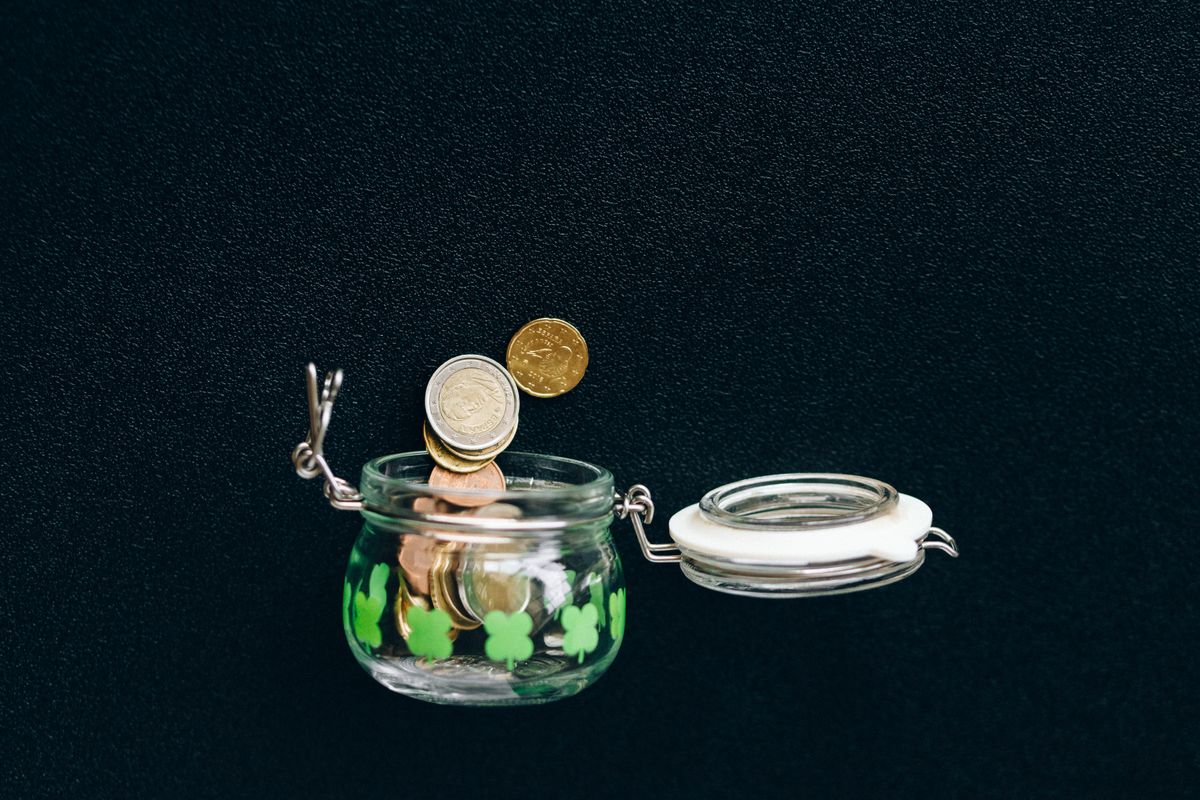
Now the honest caveat, because oversimplifying is how money myths get born. A 2024 meta-analysis in the Journal of Retailing pooled 392 effect sizes (Schomburgk et al., 2024). The cashless effect is real but small, and it has been shrinking over time. As card payments became everyone’s default, the pain gap narrowed.
So “switch to cash only” isn’t the magic move it gets sold as. The smarter play is selective friction. Keep the frictionless rails for rent and bills. Add pain back only where your spending actually leaks, like deleting the saved card from one shopping site.
We put cash and cards head to head, wince by wince, in a dedicated guide.
The myth: a budgeting app will fix your spending
Every guide in this series buries one comfortable myth, and this hub takes the biggest. Irrational Labs ran a randomized trial with 9,035 people over 13 weeks, and budgeting-app users spent the same as everyone else (Irrational Labs). Control group: $675.97. The two app groups: $681.08 and $673.25. Statistically, a flat line.
It gets stranger. In the categories where people actually set a budget, spending ran about $30 higher, not lower, with p < .001. A visible number can quietly become a target. Watching the budget may nudge you toward spending up to it.
And it’s not one odd study. A separate randomized trial gave people the budgeting app Toshl, and it points the same direction. Users checked their balances more often, but self-reported control over their money didn’t improve (Journal of Behavioral and Experimental Economics).
I tested this on myself before I ever read the research. Three months, every expense categorized, genuinely beautiful pie charts. My month-three spending matched month one within a few dollars. The app made me informed. It never once made me different.
Why doesn’t monitoring work? Because a budgeting app is a dashboard, and dashboards don’t steer. Information changes behavior only when it’s welded to a default, a friction, or a commitment. Awareness is the speedometer. The next section is the steering wheel.
The budgeting app has a famous cousin, by the way: the claim that skipping lattes makes you rich. That math gets its own autopsy in this series: the latte factor myth, audited.
What actually works when willpower doesn’t?
Automation with built-in escalation, and there’s a landmark trial behind it. In the Save More Tomorrow program, employees pre-committed a slice of their future raises to savings. 78% of those offered the plan joined, and average saving rates climbed from 3.5% to 13.6% in 40 months (Thaler & Benartzi, 2004).
Read that again. Nearly quadrupled, with no budgeting worksheets, no spending shame, no monthly review meetings. The design came from Richard Thaler, who later won a Nobel prize for this style of thinking, and Shlomo Benartzi.
The trick: it recruits your bugs instead of fighting them. Present bias makes sacrifices today feel awful and sacrifices next year feel free, so the plan only ever asks for next year’s money. Take-home pay never drops, because savings rise when raises land, so loss aversion never fires. And inertia, the force that kills gym habits, becomes your bodyguard. Leaving takes effort, so almost nobody leaves.
Here’s the difference in one table:
| Monitoring (weak) | Automation (strong) |
|---|---|
| Checks the damage after spending | Moves money before you can spend it |
| Needs your attention daily | Runs while you ignore it |
| Asks willpower to act every time | Asks for one signature, once |
You can run a personal version this week, no employer plan required. Set an automatic transfer for payday, sized embarrassingly small. Put a calendar note to raise it by 1% after your next raise. Then anchor the whole thing to a moment you already have, which is just habit stacking pointed at your bank account. If even that feels heavy right now, size it for your worst day and shrink until it’s silly.
Present bias, and how Save More Tomorrow turns it into an ally, gets the full treatment in its own guide. Save More Tomorrow and present bias
The scarcity tax: money stress isn’t just uncomfortable
Money stress eats the exact bandwidth you’d need to fix money. In 2013, a study in Science tested Indian sugarcane farmers before and after harvest. With money tight pre-harvest, their reasoning scores dropped by roughly the equivalent of 13 IQ points (Mani et al., 2013). Same farmers, same brains, different bank balance.
The proposed mechanism is scarcity itself, a bandwidth tax. Money problems capture attention the way hunger captures a dieter. Less processing power remains for everything else, including the exact planning that would ease the shortage. It’s a loop, and it isn’t a character loop.
Now the part most blogs skip: this finding got challenged. A reanalysis argued the farmer effect shrank or vanished once you corrected for things like practice effects on the tests (Wicherts & Scholten, 2013). The original team ran additional checks and stood by the result. The debate isn’t fully settled.
Where does that leave you? Probably between the headline and the debunk: the effect likely exists in some settings and is smaller than the famous number suggests. We tell you anyway, because the practical lesson survives either way. When money is tight, complex plans fail first. Simple, automated ones don’t bill bandwidth you don’t have.
Being broke isn’t a character flaw. It’s a bandwidth tax, and a tax isn’t a personality.
The scarcity tax, and how to design money habits around it on a tight month, has its own guide.
The lottery winner problem: more money doesn’t fix the feeling
If saving feels hard partly because more money looks like the real answer, meet the classic result. In 1978, researchers compared recent lottery winners with controls. The winners were no happier, and they rated everyday pleasures lower (Brickman et al., 1978).
The culprit is hedonic adaptation. Your happiness baseline works like a treadmill: big jumps feel amazing briefly, then become the new normal. Ordinary pleasures pale next to the remembered peak. The winners’ morning coffee lost flavor because a jackpot had recalibrated the whole scale.
Lifestyle creep is hedonic adaptation on a salary schedule. The raise arrives, spending quietly rises to meet it, and six months later nothing feels different except the numbers. It’s part of why a saving rate can sit at 3.0% even while incomes grow (Bureau of Economic Analysis, 2026). Creep deserves its own field guide, and it has one: the psychology of lifestyle creep.
Adaptation also runs in reverse, which is the useful part. Step off the treadmill briefly and cheap pleasures regain their flavor. That’s the honest psychological case for a structured no-spend month: not punishment, a sensitivity reset.
How do you start when money stresses you out?
Smaller than feels respectable. The evidence in this guide points one way: intentions carry about 28% of the load (Sheeran, 2002). And the program that nearly quadrupled saving asked for zero sacrifice on day one (Thaler & Benartzi, 2004). Your first money habit shouldn’t be a budget overhaul. It should be almost nothing.
Pick exactly one of these:
- Look, don’t fix. Open your banking app and look for two minutes. No judging, no spreadsheet. Avoidance is the first habit to break.
- Automate one embarrassing transfer. $5 on payday counts. You’re installing the rail, not filling the train.
- Remove one saved card. Choose the site where you leak most. Typing 16 digits is the pain of paying, reinstalled.
- Write one line to future-you. A single sentence about their Tuesday. Strangers don’t get your money; people do.
- Schedule the escalation. Calendar note, three months out: raise the transfer by 1%.
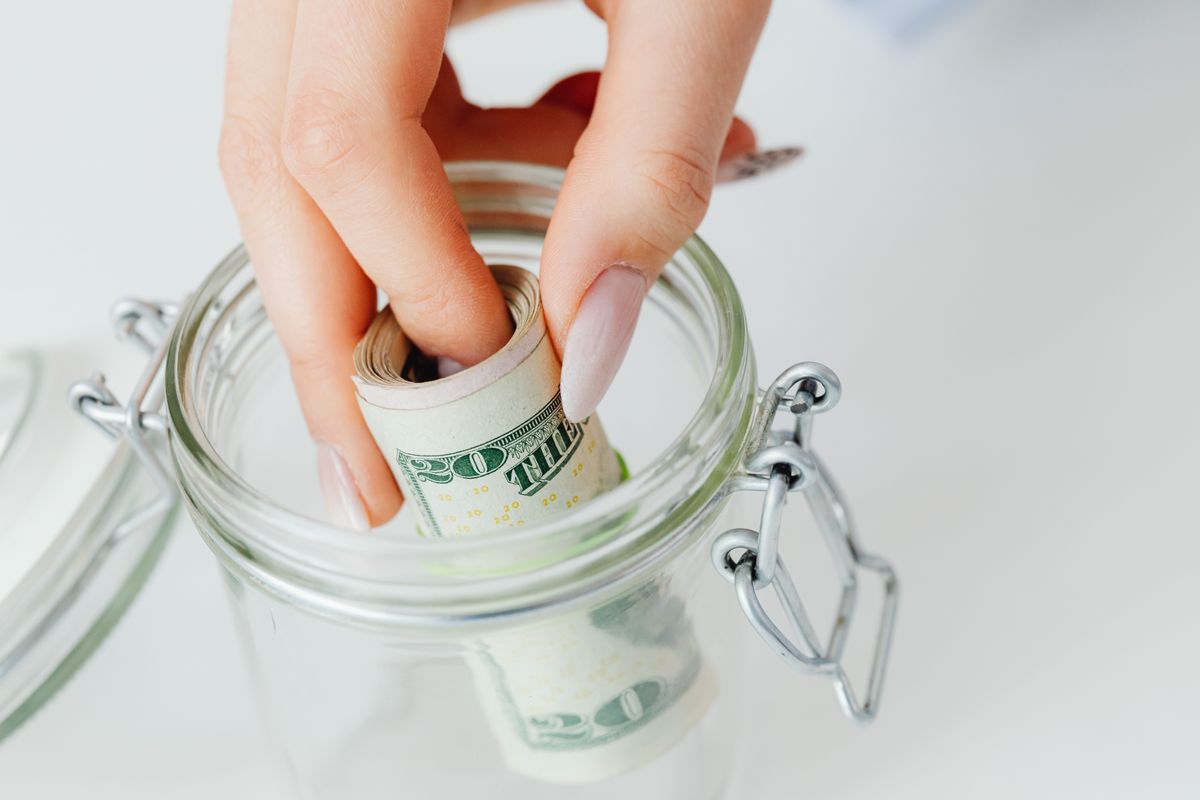
If a money habit of yours died before, welcome to the club, and here’s how to restart it without starting over. Want the day-by-day version instead? The 30-day tiny habits checklist already has a money rep built in at day 22.
One more thing. If money thoughts mostly show up at 1am, that’s not a budgeting problem, and it gets its own guide in this series. And if the worry is heavy and constant, a conversation with a real professional beats any blog, including this one.
FAQ
Is saving hard because I lack discipline?
No, and the numbers back you up. Intentions explain only about 28% of the variance in behavior (Sheeran, 2002), so sincere resolve moves little by itself. The national saving rate is 3.0% (Bureau of Economic Analysis, 2026). When nearly everyone struggles, blame the design, not the people.
Do budgeting apps actually work?
Not for changing spending, based on the best test available. A 13-week randomized trial with 9,035 people found no spending difference between app users and controls, and budgeted categories ran about $30 higher (Irrational Labs). Apps are fine for awareness. Automation is what changes behavior.
Should I switch to cash only?
Probably not. The pain of paying is real: card bidders once offered up to twice what cash bidders did (Prelec & Simester, 2001). But a 2024 meta-analysis of 392 effect sizes found the cashless effect small and shrinking (Schomburgk et al., 2024). Add friction selectively instead.
What’s the single best money habit to start with?
Behaviorally, an automatic transfer small enough that you won’t notice it, with scheduled increases. That’s the Save More Tomorrow design, which took average saving rates from 3.5% to 13.6% in 40 months (Thaler & Benartzi, 2004). Size it for your worst week, then let escalation do the growing.
The Bottom Line
Saving isn’t hard because you’re undisciplined. It’s hard because the buyer is vivid while the beneficiary is a stranger. Because cards muted the pain that used to regulate spending. And because monitoring informs without changing anything. The fixes that survive real life are boring: make future-you vivid, automate the transfer, schedule the increases, and add friction where you leak. Boring is what working looks like.
Looking is the first pass. The Overspending Autopsy is the second: four printable leak pages, each with its mechanism, a fill-in audit of your real numbers, and one fix.
One small action today: open your banking app and just look for two minutes. No fixing, no judging, only looking. It’s day 22 of the 30-day tiny habits checklist for a reason: you can’t automate an account you won’t open.
Alex is the voice of Self Lab: practical psychology for people who are done with motivational fluff.
Sources
- Bureau of Economic Analysis, Personal Saving Rate (May 2026, 3.0%), retrieved 2026-07-12, https://www.bea.gov/data/income-saving/personal-saving-rate
- Federal Reserve Board, “Economic Well-Being of U.S. Households in 2025” (SHED), savings and investments chapter, retrieved 2026-07-12, https://www.federalreserve.gov/publications/2026-economic-well-being-of-us-households-in-2025-savings-investments.htm
- European Review of Social Psychology, Sheeran, “Intention-Behavior Relations: A Conceptual and Empirical Review” (2002), retrieved 2026-07-12, https://www.tandfonline.com/doi/abs/10.1080/14792772143000003
- Social Cognitive and Affective Neuroscience (via PubMed Central), Ersner-Hershfield, Wimmer & Knutson, “Saving for the future self: neural measures of future self-continuity predict temporal discounting” (2009), retrieved 2026-07-12, https://pmc.ncbi.nlm.nih.gov/articles/PMC2656877/
- Journal of Marketing Research (via PubMed Central), Hershfield et al., “Increasing Saving Behavior Through Age-Progressed Renderings of the Future Self”, retrieved 2026-07-12, https://pmc.ncbi.nlm.nih.gov/articles/PMC3949005/
- Marketing Letters (Springer), Prelec & Simester, “Always Leave Home Without It: A Further Investigation of the Credit-Card Effect on Willingness to Pay”, retrieved 2026-07-12, https://link.springer.com/article/10.1023/A:1008196717017
- Journal of Retailing (ScienceDirect), Schomburgk et al., meta-analysis of the cashless effect across 392 effect sizes, retrieved 2026-07-12, https://www.sciencedirect.com/science/article/pii/S0022435924000216
- ResearchGate, Zellermayer, “The Pain of Paying” (Carnegie Mellon dissertation, 1996), retrieved 2026-07-12, https://www.researchgate.net/publication/280711796_The_Pain_of_Paying
- Journal of Political Economy (via besci.org), Thaler & Benartzi, “Save More Tomorrow: Using Behavioral Economics to Increase Employee Saving”, retrieved 2026-07-12, https://besci.org/papers/benartzi-thaler-2004
- Science, Mani, Mullainathan, Shafir & Zhao, “Poverty impedes cognitive function”, retrieved 2026-07-12, https://www.science.org/doi/10.1126/science.1238041
- Science, Wicherts & Scholten, “Comment on ‘Poverty Impedes Cognitive Function’”, retrieved 2026-07-12, https://www.science.org/doi/10.1126/science.1246680
- Science, Mani, Mullainathan, Shafir & Zhao, “Response to Comment on ‘Poverty Impedes Cognitive Function’”, retrieved 2026-07-12, https://www.science.org/doi/10.1126/science.1246799
- Journal of Personality and Social Psychology (via PubMed), Brickman, Coates & Janoff-Bulman, “Lottery winners and accident victims: is happiness relative?”, retrieved 2026-07-12, https://pubmed.ncbi.nlm.nih.gov/690806/
- Irrational Labs, randomized budgeting experiment (n=9,035, 13 weeks), retrieved 2026-07-12, https://irrationallabs.com/blog/money-budgeting-experiment/
- Journal of Behavioral and Experimental Economics (ScienceDirect), randomized controlled trial with the budgeting app Toshl, retrieved 2026-07-12, https://www.sciencedirect.com/science/article/abs/pii/S2214804318301642
A free gift
Open the gift. We're not saying what's inside.
It's free, it fits on two pages, and it might ruin a few pieces of self-help advice for you. Open it?
One step left
It's The Debunk Deck.
Eight famous self-improvement rules that failed the science, with the study that killed each one and a line you fill in to make it yours. Two printable pages, in your inbox in under a minute.
Confirm your email and it lands in your inbox. One short email a week after that. Unsubscribe anytime.